
Why HST
When Technology Disappears, Experience Remains.
For decades, technology has been added to architecture. HST was created around a different belief: technology should support the experience without competing for attention. Architectural Audio Technology enables sound to become part of the environment while allowing architecture to remain the hero.
The Problem
The Problem With Traditional Thinking.
For decades, audio systems have been designed around equipment. Architecture has often been expected to adapt.
Traditional approaches typically begin with hardware. Speakers must be positioned. Equipment must be accommodated. Design decisions are often influenced by technical requirements.
Over time, this has become accepted as normal. Yet architecture is rarely created to showcase technology. It is created to support human experience.
What if technology could adapt to architecture instead?
The Comparison
The Same Space.
Two Different Approaches.
One approach fills the room with devices. The other disappears entirely — leaving only the architecture and the sound.
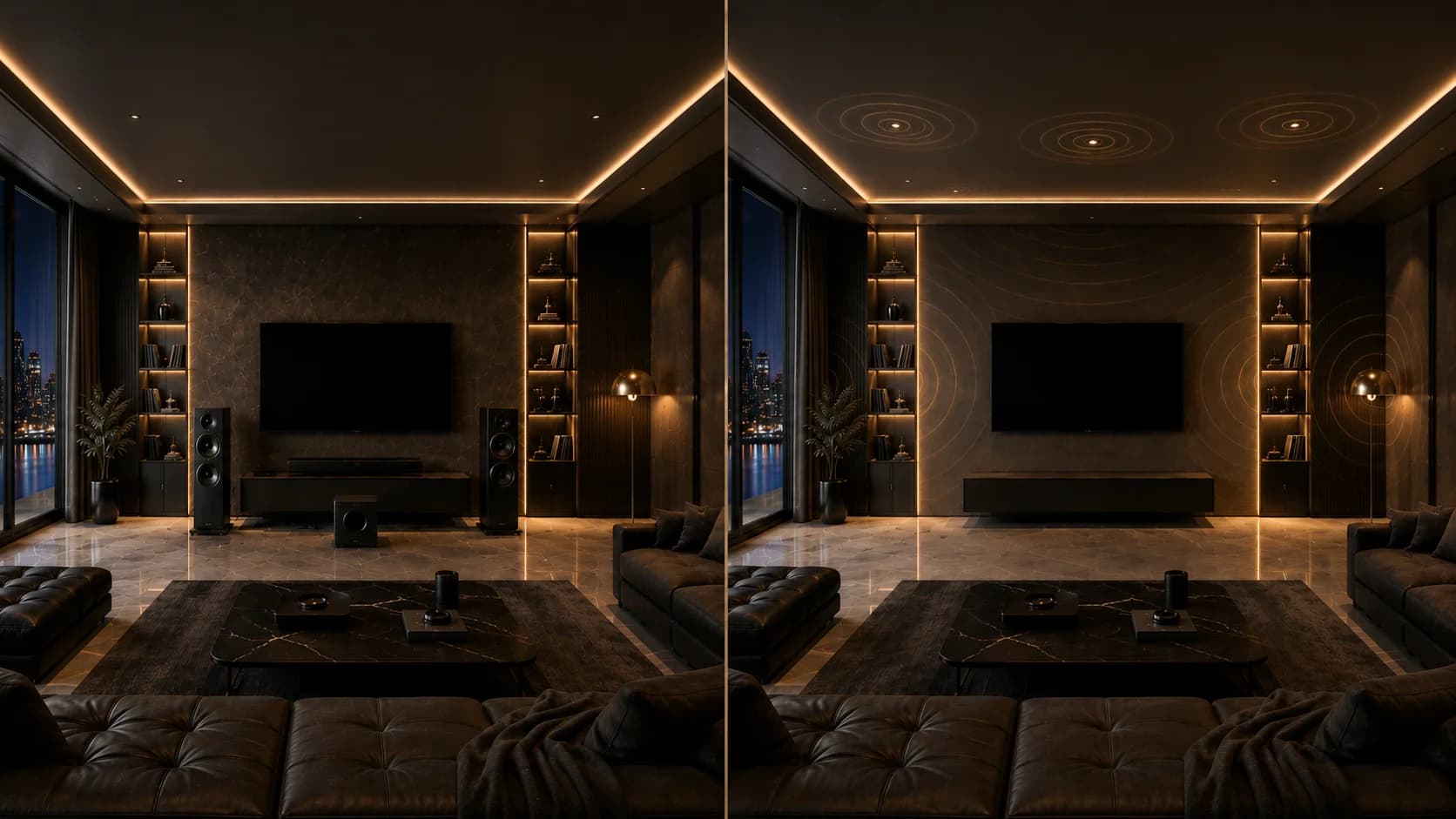
Traditional Audio
Floor-standing speakers. Soundbar. Subwoofer. Technology occupies the room.
HST Vibroacoustic
No devices. No cables. No compromise. The surface itself becomes the speaker.
A Different Approach
Technology In Service Of Architecture.
HST was created around a fundamentally different design principle. Rather than asking architecture to accommodate technology, HST asks technology to serve architecture.
The result is a system where the technology becomes invisible — not as a compromise, but as the intended outcome.
Architecture remains untouched.
No grilles. No housings. No visible components of any kind.
Sound is distributed, not localised.
The entire surface area becomes the acoustic source rather than a single point.
Experience is the outcome.
Visitors and residents experience the environment, not the equipment that supports it.
Design Without Compromise
Design Without Compromise.
The most common question from architects encountering HST for the first time is: where is the compromise?
There is no compromise. The technology is genuinely invisible. The design intent is genuinely preserved. The acoustic performance is genuinely high quality.
This is not a clever workaround. It is the fundamental purpose of the technology.
Experience Over Equipment
Experience Over Equipment.
The most successful environments are those where guests and residents remember the experience — the atmosphere, the quality, the sense of place — rather than the specific equipment that created it.
When visitors to an HST-equipped environment are asked what they notice about the sound, the most common response is that they do not notice the sound at all. They simply notice that the environment feels exceptional.
That is the objective. Not to create impressive technology. To create impressive environments.
Architecture First
Architecture First. Technology Second. Experience Always.
Architecture First
Every HST deployment begins with the architecture. The design intent is understood, respected and preserved throughout the process.
Technology Second
Technology is the means, not the end. HST is introduced to serve the architectural vision — never to compete with it.
Experience Always
The final measure of every HST deployment is the quality of the experience it creates — for residents, guests, visitors and operators.
Real-World Deployment
Built For Real-World Deployment.
HST is not a laboratory technology or a concept project. It has been deployed across premium environments in Italy, the UAE, Saudi Arabia and Switzerland — in five-star hotels, private villas, luxury retail, wellness facilities and outdoor architectural environments.
- —Deployed in five-star hospitality in Dubai
- —Private residential environments across Italy and the GCC
- —Luxury retail in Dubai Mall
- —Outdoor and architectural feature installations in Switzerland and Italy
Every deployment confirms that invisible technology and exceptional acoustic performance are entirely compatible.
Designed to Last
Zero Maintenance. Minimal Energy. Maximum Longevity.
HST was engineered around the same principle that guides the best architecture: nothing that does not need to be there should be there. This extends to energy and maintenance.
HST Patches — zero energy consumption
The HST Patch is a passive piezoelectric element. It consumes no energy of its own. It has no moving parts. It does not wear. Once correctly installed, it requires no maintenance for the lifetime of the building or the surface it occupies.
Complete system — approximately 25W
The entire HST system — powering up to 30 active surfaces simultaneously — consumes approximately 25 watts total. The equivalent of a single light bulb. Designed for always-on operation with no meaningful impact on building energy consumption.
HST Amplifier — 2-year warranty, built to last
The HST Amplifier carries a 2-year warranty. In practice, quality amplification hardware of this specification typically operates reliably for many years beyond this. It is the only component in the system that could ever require attention — and that eventuality is rare.
A system that disappears visually, consumes almost nothing, and requires no maintenance is not a product. It is infrastructure.
A Different Perspective
A Different Way To Think About Sound.
Sound does not need a source that can be seen.
Technology does not need to announce itself to be effective.
Architecture does not need to adapt to technology.
Experience is more powerful than equipment.
HST exists because these beliefs are not just possible. They are achievable — in real projects, in real environments, for real clients. Our founding conviction →
“The most powerful sound system is the one you never see — and the one that feels like it has always been part of the space.”
HST Vibroacoustic Technologies
Convinced That Technology Should Serve Architecture?
The next step is understanding how HST can serve your specific project, environment or market.